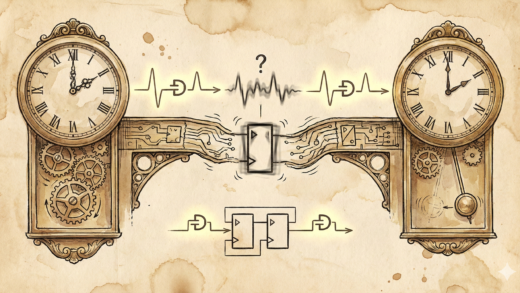

The most dangerous misconception a junior engineer can have is thinking that writing HDL is like writing software. It looks like code, it compiles like code, but it behaves like electricity.
When you write C or Python, you are creating a sequence of instructions for a processor to execute one by one. When you write HDL (Hardware Description Language), you are literally wiring transistors together. You are describing a physical circuit that exists in parallel, everywhere, all at once.
In the industry, the “Holy Trinity” of HDLs dictates the workflow: Verilog, VHDL, and the modern giant, SystemVerilog. Which one should you master? Let’s break down the architecture of each.
1. Verilog: The “Quick and Dirty” Standard
Created in the 1980s specifically for simulation, Verilog syntax was modeled after C to make it familiar to software engineers. This is both its greatest strength and its biggest weakness.
Verilog is loosely typed. It lets you connect a 10-bit wire to an 8-bit port without a warning, simply truncating the bits. This allows for rapid prototyping but can lead to nightmare debugging sessions if you aren’t disciplined. It is the dominant language in the ASIC world and Silicon Valley.
2. VHDL: The Military Grade Fortress
VHDL (VHSIC Hardware Description Language) is based on Ada. It is strongly typed, verbose, and unforgiving. If you try to mix a `std_logic` with a `bit`, the compiler will stop you immediately.
Because of this strictness, VHDL is preferred in industries where failure is not an option: Defense, Aerospace, and Avionics (FPGA designs for F-35s or Mars Rovers are mostly VHDL). It forces you to be explicit about every signal conversion.
3. SystemVerilog: The Modern King
SystemVerilog (SV) is not just an update; it’s a revolution. It combined the simplicity of Verilog with the strictness of VHDL and added Object-Oriented Programming (OOP) features for verification.
SV introduces high-level structures like `interface`, `struct`, and `always_ff`, which clarify intent to the synthesis tool, reducing the chance of simulation-synthesis mismatches.
Final Thoughts: It’s Not About the Syntax
Asking “Which language is better?” is the wrong question. The real skill of an FPGA engineer isn’t knowing the syntax of a `case` statement; it’s knowing how that statement translates into Look-Up Tables (LUTs) and Multiplexers.
My advice? Learn SystemVerilog for design efficiency, but be able to read VHDL because legacy IP cores are everywhere. The language is just a tool; the architecture is the art.
Happy coding.
fpgawizard.com